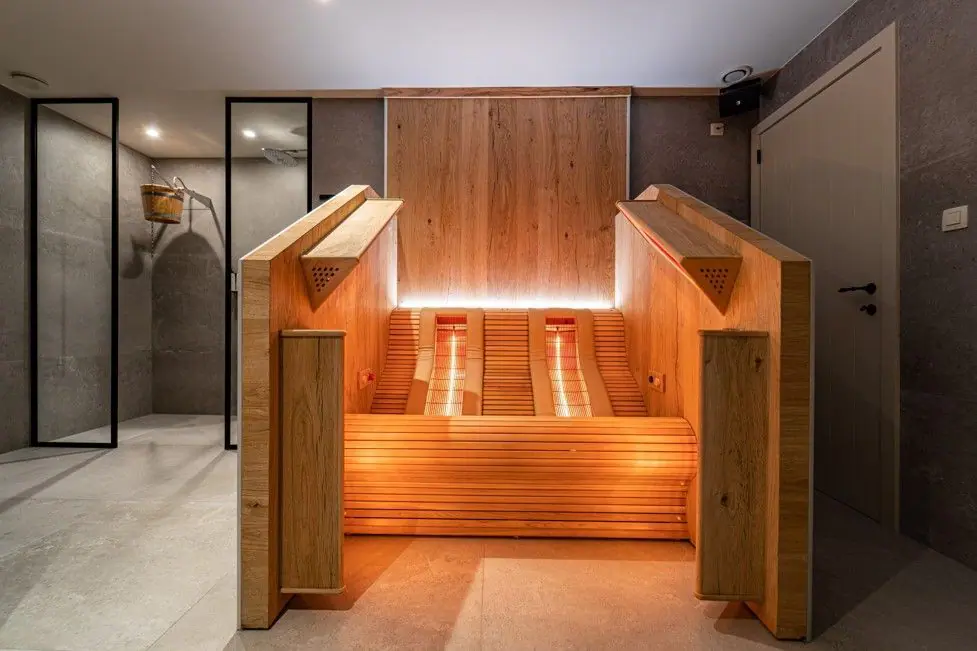
Prefabricated or bespoke sauna: compare layout, customisation, building work and cost factors for your venue.
In this article
- The prefabricated sauna kit: a turnkey solution for rapid roll-out
- The bespoke sauna: premium equipment for a prestige venue
- Commercial comparison: sauna kit vs bespoke build
- Decision guide: which equipment for which venue?
- The hybrid alternative: a strategic compromise for mid-range venues
- Sector examples: matching the solution to the venue
- Conclusion: a strategic investment suited to your situation
- Sector-specific FAQs
As a hotel director, fitness centre manager, wellness institute manager, interior or exterior architect, landscaper or local-authority facilities manager, you regularly face a key question: should you equip your venue with a prefabricated sauna kit, or invest in a bespoke build?
This choice is not just about budget or aesthetics. It is a major strategic decision that directly affects your return on investment, guest experience, energy use and market positioning.
This guide will help you assess each solution for your circumstances (venue size, expected usage, premium positioning and space constraints) and structure your investment wisely.
The prefabricated sauna kit: a turnkey solution for rapid roll-out
What is a sauna kit in a commercial setting?
A prefabricated sauna is a standardised, modular fit-out solution made of pre-assembled panels supplied as a turnkey package. Installation can be completed in just a few hours, without major structural work or loss of business for your venue.
For a commercial venue, prefabricated models have dimensions and equipment specified in a catalogue. Before planning commissioning, check access, connections, ventilation and whether the model suits the intended use.
The strategic advantages of a kit for your venue
Installation needs planning
Business continuity is essential for a hotel, fitness centre or gym. The schedule for a sauna kit depends on availability, room preparation and connections. Expected admission revenue should be weighed against project costs and operating expenses.
For a local-authority facility or public swimming pool, compare the complete cost of each solution: purchase, room preparation, installation, energy use and maintenance. Expected attendance and commercial use should guide model selection.
Reliable equipment built to standards
Kits benefit from strict manufacturing requirements, including CE and electrical standards, and certification for intensive commercial use. They reduce the risk of unexpected downtime and come with manufacturer-backed after-sales support. For premises welcoming the public, this is a major advantage.
Energy consumption factors to examine
Ask about installed power, maintenance requirements and operating conditions for the chosen model. Electricity costs are calculated from actual operation, preheating and the energy tariff; they cannot be inferred from the kit format alone.
Space flexibility for smaller venues
For a gym with a small wellness area, a compact institute or a budget-constrained local-authority facility, a kit can fit the available dimensions. A 90 × 90 or 100 × 100 cm model already adds real value.
Creating several points of interest
A hotel director can install several small sauna kits (one per floor or wellness zone) instead of a single large central facility. This enriches the guest experience without major building work.
Limitations to anticipate
Limited premium differentiation
If your venue is positioned at the premium end (a 5-star hotel, luxury spa or prestige institute), a standard sauna kit may disappoint. Guests expect a distinctive aesthetic, premium finishes and unique design. A kit offers a generic product they may see in competing hotels.
A basic user experience
No panoramic glazing, rare wood species or sophisticated ambient lighting. It is a functional sauna, rather than an experience-defining feature.
Thermal performance under intensive use
For a busy venue, compare the insulation, ventilation and controls of the proposed models. Check their suitability for commercial use and ask how maintenance will be organised during peak periods.
Service life and maintenance
Service life depends on the model, usage, installation conditions and maintenance. Include servicing and parts replacement in the budget, using the supplier's documentation and commitments as your basis.
The bespoke sauna: premium equipment for a prestige venue
What is a bespoke sauna in a commercial project?
A bespoke sauna is built entirely on site and designed specifically for your venue: optimised geometry to make the most of available space, thermal insulation for intensive use, high-performance mechanical ventilation, selected wood species and a distinctive design aligned with your brand identity.
For a premium venue director, architect or landscaper, it is a flagship facility that shapes the experience and sets the venue apart in the market.
The strategic advantages of bespoke design for your venue
A market differentiator and marketing asset
For an upmarket hotel, spa or institute, bespoke design allows an identity consistent with the setting. Its impact on attendance or pricing should be assessed against the clientele and existing offer, without assuming additional revenue.
For a fitness centre positioned in premium wellness, a bespoke sauna with clean design, panoramic glazing and ambient lighting strengthens your positioning and builds loyalty among discerning guests.
Space optimisation for your unique setting
Every venue has a different geometry: alcoves, sloping ceilings, complex corners and leftover spaces. Bespoke design turns these constraints into assets. A hotel with an unusual courtyard? The sauna can fit perfectly.
For a landscaper designing an outdoor wellness circuit, a bespoke sauna can be set beneath a green roof or integrated into a landscaped terrace. This is architecture in its own right.
Sizing for the intended use
Insulation, ventilation, vapour barrier and controls are defined with the project's specialists. Sizing must account for attendance and opening hours to prepare the cabin for operation.
For a busy public facility, such as a municipal swimming pool or fitness centre, it is an investment in durability and reliability.
Compare the complete cost
Compare solutions by their total cost: installation, energy use, maintenance, parts and potential service visits. Possible savings depend on insulation, controls and operating conditions. They should be evaluated for comparable usage, using project-specific data.
A lasting part of the building
Integrating a sauna into a building can form part of a long-term fit-out strategy. Its effect on property value depends on the property and market and requires a specific assessment; there is no automatic percentage increase.
A premium guest experience
With bespoke design, materials, lighting and openings can be coordinated with the atmosphere of the venue. Wellness package pricing still needs to reflect the full range of services and your guests' expectations.
Limitations to manage
A significant investment and lead time
Budget and schedule depend on the design, materials, access and required work. Request a detailed quotation and schedule separating manufacture, room preparation and installation, especially if the venue remains open.
Reliance on specialist contractors
You need to control the quality of execution. Assemble a team of reliable tradespeople from the outset. That is your responsibility as the manager.
A permanent installation
Unlike a kit, a bespoke sauna is permanent. You need genuine confidence from the outset that it is right for your venue. But that is also an advantage: it is an asset you retain and develop.
Commercial comparison: sauna kit vs bespoke build
- Entry budget: kit: an accessible budget (€2,000–5,000); bespoke: a premium investment (€10,000–25,000)
- Implementation time: for both solutions, confirm the schedule according to availability, room preparation, access and connections.
- Technology: kit: pre-assembled panels with a clip system; bespoke: built on site with integrated mechanical ventilation
- Customisation: kit: limited to the catalogue; bespoke: fully tailored to plans
- Fit for unusual spaces: kit: limited by standard dimensions; bespoke: an exact fit for sloping ceilings and corners
- Mobility: kit: can be dismantled and transported; bespoke: fixed and permanent
- Thermal insulation: kit: adequate sandwich panels; bespoke: superior mineral-wool insulation
- Mechanical ventilation: kit: basic or manual; bespoke: optimised and powered
- Electricity consumption: estimate for each model according to power, controls, preheating and operating hours.
- Monthly electricity cost (1 hour/day): calculate from estimated kWh and the applicable energy tariff; one hour of guest access does not describe the whole day's operation.
- Design and appearance: kit: standard and conventional; bespoke: premium and personalised
- Choice of wood species: kit: 2–3 limited options; bespoke: countless possibilities, including aspen and abachi
- Panoramic glazing: kit: not available; bespoke: possible and elegant
- Integrated LED lighting: kit: basic or absent; bespoke: customised indirect LED lighting
- Installation complexity: kit: suitable for a beginner DIYer; bespoke: requires a professional
- Maintenance: kit: simple and self-managed; bespoke: standard, with robust parts
- Spare parts availability: kit: easy to find; bespoke: specialised but available
- Estimated lifespan: depends on the model, attendance, installation and maintenance; discuss with the supplier.
- Property value: assess according to the property, project integration and local market, without assuming a quantified increase.
- Ideal user profile: kit: interior designers, quick residential projects and limited client budgets; bespoke: premium architects, high-end projects and complex, unusual spaces
- Satisfaction profile: kit: high with realistic expectations; bespoke: high and lasting
Decision guide: which equipment for which venue?
Choose a kit if:
- You manage a gym or small fitness centre and want to consider a standardised solution. Compare its total cost with projected additional revenue, including operating expenses.
- You manage a local-authority facility with strict budget requirements. Check that a prefabricated model meets the attendance levels and operating conditions of your venue.
- You have a small space or standard dimensions. A gym with 6 × 4 m available can accommodate 1–2 kits without reconfiguration.
- Your positioning is accessible rather than prestigious. You want to expand your offer quickly, not create a signature brand feature.
- You are launching a new concept and want to test demand without a major commitment.
Choose bespoke if:
- You want a distinctive identity for your hotel, spa or institute. Bespoke design coordinates the sauna with the architecture and the overall wellness offer.
- You face complex space constraints: an unusual alcove, sloping ceiling, courtyard, landscaped setting or awkward corners. Bespoke design turns these problems into aesthetic assets.
- Your venue anticipates intensive use. Ask for details of sizing, operating conditions and the maintenance programme for every proposed solution.
- You own the building and want the sauna to become a lasting part of its layout. Any effect on the property's value requires a specific assessment.
- You are working with an architect or landscaper on a renovation or high-end project. A bespoke sauna fits an approach centred on architectural excellence.
The hybrid alternative: a strategic compromise for mid-range venues
There is an interesting third option for mid-range venues or those moving upmarket: buy a sauna kit and customise it intelligently.
- Professional architectural cladding: add a timber or stone structure around the kit to integrate it into your aesthetic. Cost: an additional €2,000–4,000. The result: a sauna that looks bespoke with a kit's lead time.
- Premium heater: replace the standard heater with a higher-performance model, such as infrared or a premium Finnish heater. Cost: an additional €1,000–2,500.
- Ambient lighting and chromotherapy: integrate a programmable colour-changing LED system. Cost: an additional €800–1,500.
- Improved ventilation: install high-capacity mechanical ventilation for intensive use. Cost: an additional €1,200–2,000.
This compromise costs between €5,000 and €9,000 and creates a distinctive identity without bespoke lead times. It is a smart option for a fitness centre seeking to stand out or a small hotel strengthening its wellness positioning.
Sector examples: matching the solution to the venue
Premium hotels and residences
Strategy: bespoke, premium or hybrid. The hotel or residence may be seeking a distinctive architectural signature. Openings, lighting and wood species are chosen with the designer to ensure a coherent space.
Assess the equipment's place in the offer, guest expectations and achievable pricing. Effects on bookings or loyalty are not guaranteed revenue.
Fitness centres and gyms
Strategy: kit for entry-level projects, or hybrid for stronger positioning. A gym can compare a kit with a customised solution based on available space, intended use and budget. Financial viability depends on admissions sold and additional operating costs.
Calculate revenue from packages actually purchased, then the additional energy, maintenance and management costs. Projected turnover is not, by itself, profit.
Wellness institutes and spas
Strategy: bespoke, with specialist premium positioning. A wellness institute or spa depends on its guest experience. A bespoke sauna is a critical part of its positioning. Design, materials and spatial integration all matter. It is your signature.
Assess how sauna access fits into packages and the price guests are willing to pay, without assuming it automatically supports a price increase.
Public swimming pools and aquatic centres
Strategy: kit for a public-sector budget, or bespoke for an ambitious local authority. A public pool with a limited budget chooses a kit. A local authority looking to strengthen its tourism appeal or justify public admission prices may invest in bespoke facilities for an attractive, distinctive thermal circuit.
Assess public-service objectives, expected attendance and the operating budget. Any revenue assumptions must reflect the local authority's pricing policy.
Architects, landscapers and designers
Strategy: bespoke, with an architectural signature. For an architect designing a high-end project or a landscaper creating an outdoor wellness space, a bespoke sauna becomes a major architectural feature. It sets your work apart for premium clients.
Assess the scope of the commission, design work and fees agreed with the client.
Conclusion: a strategic investment suited to your situation
As a venue decision-maker, architect or space manager, your role is to choose equipment that optimises direct return on investment through admissions and indirect return through loyalty, prestige and added value.
The kit: catalogue-defined dimensions and equipment, to be checked against the room, attendance and complete budget. Ease of installation depends on the project's conditions.
The bespoke option: design tailored to the place and fit-out choices. Compare its cost, maintenance and integration with other solutions without assuming profitability.
The hybrid option: a sound compromise for mid-range venues seeking a signature feature without a major commitment.
The real question is not ‘kit or bespoke?’, but ‘which sauna maximises my return on investment and strengthens my market positioning?’
Sector-specific FAQs
I manage a 3-star hotel. Can a bespoke sauna pay for itself?
That depends on the complete cost, intended use and your commercial offer. Compare prefabricated, customised and bespoke solutions using the same attendance assumptions. Deduct operating costs from additional revenue before estimating any payback period.
I manage a public swimming pool. Is a kit enough for 500 visits a week?
Total site visits alone are not enough to size a sauna. Specify expected sauna users, peak attendance and operating hours, then check the model's suitability with its supplier. Include maintenance and service visits in the budget.
What is the real marketing benefit of a bespoke sauna for my hotel?
The project's value is measured against your objectives: quality of use, architectural integration, service offering and financial balance. Changes in pricing, attendance or property value require assumptions and an assessment specific to your venue.
Can a kit pay for itself in less than a year?
No payback period can be inferred from the purchase price alone. Calculate realistic additional revenue, subtract all extra costs, then compare the balance with the full investment cost. Also test a lower-attendance scenario.
Does a bespoke sauna require specialist maintenance expertise?
No. Basic weekly cleaning, annual wood treatment and a mechanical ventilation check once or twice a year. These can be delegated to your team or covered by a manufacturer maintenance contract (€100–200 per month).