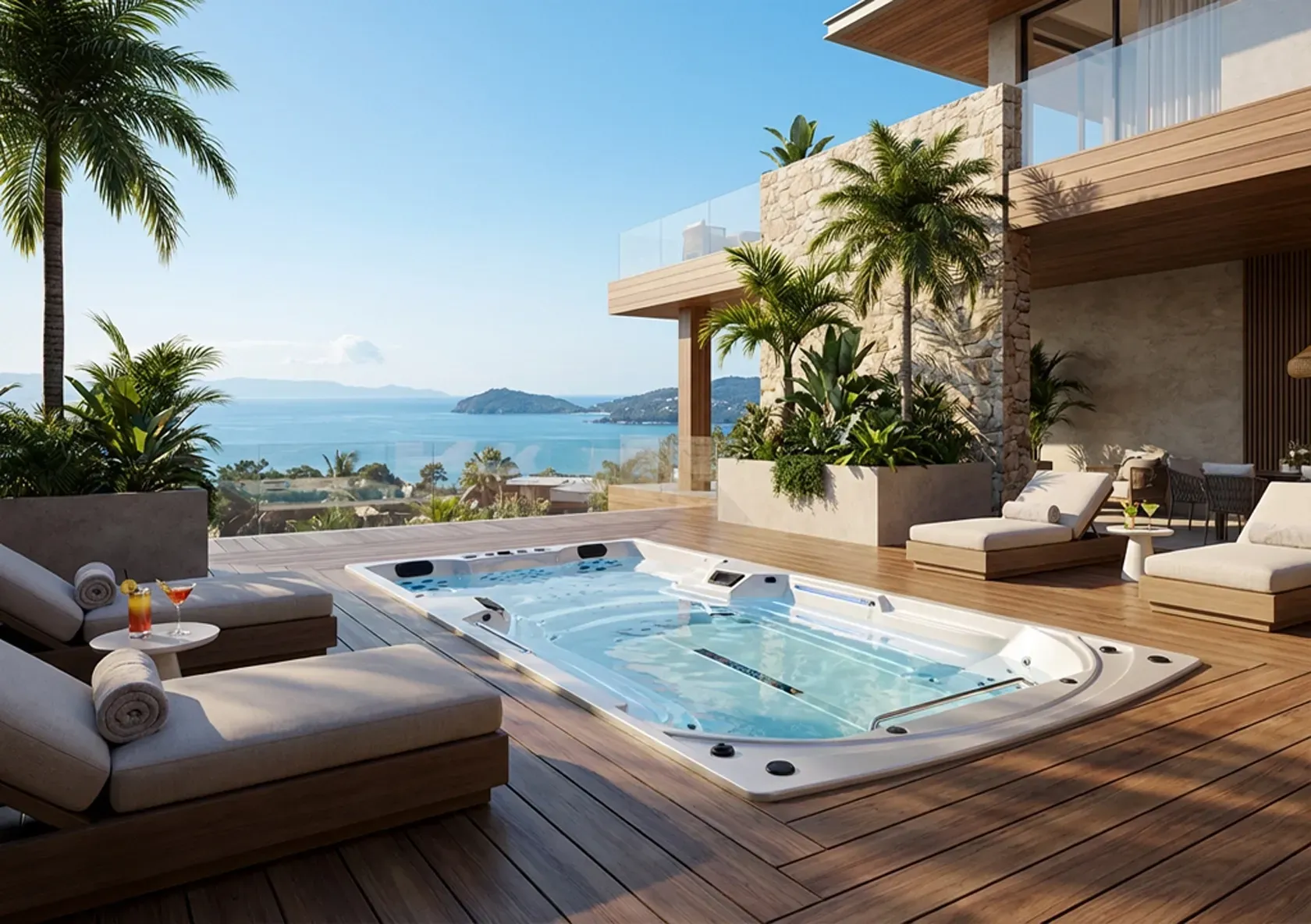
Investing in a commercial swim spa? Discover the 5 technical criteria (turbine, dual-zone layout, insulation and French ARS requirements) for choosing profitable, durable equipment.
In this article
- Counter-current power: the heart of the system
- Structure and insulation: ensuring durability
- Single-zone or dual-zone: matching your business model
- Hygiene compliance and commercial filtration
- Depth, accessories and after-sales service
- Conclusion: investing wisely
- FAQ: commercial swim spas, your questions answered
Are you considering investing in a commercial swim spa for your hotel, rehabilitation centre or fitness space? This is a strategic decision that deserves careful thought. The market is full of products labelled ‘professional’ that are really leisure equipment in disguise. Here are the technical criteria that make the difference between a profitable investment and a costly disappointment.
1. Counter-current power: the heart of the system
This is the number-one criterion that separates a genuine commercial swim spa from a simple heated bathtub.
Turbines vs pumps: the real difference
Entry-level systems use return jets driven by basic pumps. The result? Turbulent, unstable flow that is impossible to regulate. For effective rehabilitation or counter-current swimming, that is a deal-breaker.
Genuine commercial systems use a turbine or propeller to generate stable, adjustable laminar flow. Resistance can be matched to the desired intensity, essential for accommodating both a triathlete and a patient undergoing cardiac rehabilitation.
Essential checks:
- Flow rate in m³/h (at least 8–10 m³/h for intensive use)
- Adjustable power (dimmer or variable-speed control)
- Manufacturer's certification of the flow type (laminar)
2. Structure and insulation: ensuring durability
This determines your profitability over 10 years. A fragile spa means soaring maintenance costs.
The shell and frame
Choose a recognised acrylic brand such as Aristech, reinforced with fibreglass, rather than cheap imported ABS shells that crack within 3 years. The frame should be stainless steel or rot-resistant composite. ‘Solid’ wood structures swell and rot: a nightmare.
Thermal insulation: your financial advantage
Often overlooked, insulation nevertheless determines your electricity bill. A poorly insulated spa in a 4-star hotel can cost €2,000–3,000 a year to heat.
- Look for full perimeter insulation or a Full Foam system (continuous expanding foam). The insulation should allow year-round use without excessive running costs. This is where your investment pays for itself.
3. Single-zone or dual-zone: matching your business model
Single-zone = one area with a uniform temperature (~28°C). Ideal for dedicated exercise or intensive aqua fitness.
Dual-zone = two separate pools: a cooler swimming area (26–28°C) and a warm spa area (36–37°C). This is the strategic choice for:
- Hotels and spas that need to serve two audiences at once
- Wellness centres looking to maximise the appeal of the equipment
- Rehabilitation facilities offering both swimming and thermal recovery
SpaPRO offers dual-zone configurations designed for this versatility. Attract more guests while making the best use of the equipment.
4. Hygiene compliance and commercial filtration
In commercial use, this is non-negotiable. Inadequate filtration can mean an administrative closure.
For premises open to the public in France (hotels and centres), you need:
- A purification system (ozone or UV-C) in addition to mechanical filtration
- A balance tank to regulate flow
- Filters meeting French ARS/DDASS requirements (where applicable in your region)
Few manufacturers communicate clearly on these points. SpaPRO includes these elements in its commercial ranges, ensuring compliance and regulatory peace of mind.
5. Depth, accessories and after-sales service
- Minimum depth: 1.30 m for comfortable swimming (130–140 cm for smaller models)
- Accessories: aquatic rowing equipment, swimming tether pole and underwater treadmill (depending on your offering)
- Parts availability: require a minimum 10-year parts guarantee
- Responsive after-sales service: avoid closing your facility when a breakdown occurs
Conclusion: investing wisely
A commercial swim spa represents an investment starting at €25,000–60,000. The difference between profitable equipment and an ongoing burden lies in these often-overlooked technical criteria.
FAQ: commercial swim spas, your questions answered
What is the difference between a leisure swim spa and a commercial swim spa?
A commercial swim spa is sized and designed for intensive use: several users each day and extended operating hours. It includes a high-performance turbine, commercial filtration meeting French ARS/DDASS requirements, reinforced thermal insulation and a robust frame. A leisure spa is intended for occasional use, a few hours per week.
What budget should you allow for a commercial swim spa?
A genuine commercial swim spa starts at between €25,000 and €60,000, depending on options: single-zone or dual-zone layout, turbine power and accessories. It is a substantial investment, but one that can be amortised over 10–15 years with well-optimised use.
How long does it take to install a swim spa?
Installation generally takes 5–10 days depending on conditions: ground preparation, electrical connections and filling. Some pre-equipped models can be operational within 3–5 days.
Does a commercial swim spa need to be declared to the health authorities?
Yes, if it is in premises open to the public or offers rehabilitation services. In France, notifying the regional health agency (ARS) is recommended to ensure compliance. SpaPRO can assist you with these administrative procedures.